|
|
The 9th of Dhu'l Hijjah is known as 'the Day of `Arafah,' because the pilgrims at Hajj gather at `Arafah in worship, which is one of the three central integrals of the Hajj rituals. Its importance is such that the Prophet (Allah bless him and give him peace) said, "Hajj is `Arafah."
[Reported in most major hadith works] |
Prophet Muhammad (saws) has said about the first ten days of Dhul-Hijjah: "There are no days in which righteous deeds are more beloved to Allah than these ten days." The people asked, "Not even Jihad for the sake of Allah?" He said, "Not even Jihad for the sake of Allah, except in the case of a man who went out to fight giving himself and his wealth up for the cause, and came back with nothing" [Sahih al-Bukhari].
So sacred are the first ten days of Dhul-Hijjah that Allah swears an oath by them when He says in the Quran: "By the dawn; by the ten nights" [al-Fajr 89:1-2]. Swearing an oath by something indicates its importance and great benefit.
While any good deed done for the sake of Allah according to the way He approves will be rewarded immensely during the first ten days, InshaAllah, some of the more specific actions mentioned in the traditions of the Prophet (salAllahu alayhi wasalam) are fasting and verbal Dhikr (remembrance) of Allah.
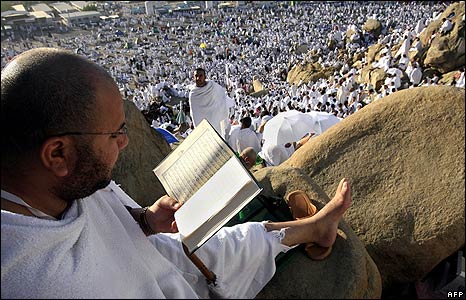
The day of Arafah is the day when the pilgrims stand in worship on the Mountain of Arafah. It is the best day of the Whole Year.
- Fasting the day of Arafah expiates the [minor] sins of two years: a past one and a coming one. And fasting the day of Ashura expiates the sins of the past year. [Muslim]
- There is no day on which Allah frees people from the Fire as He does no the day of Arafah. He comes close (to those standing on Arafah) and then revels before His angels, saying: "What are these people seeking?"
- Good Deeds. Generally, all good deeds are rewarded highly at this blessed time. These actions include praying, reading Quran, making Du'a (supplication), giving in charity and being good to our families, and other voluntary (nafl) righteous deeds of worship. These are amongst the deeds that are multiplied.
In these days.
- Seek Allah's Forgiveness and Repentance. In addition, seeking Allah's forgiveness (istighfar) and Tawbah (repentance) at this time is also encouraged. This means more than just a verbal statement of sorrow for past misdeeds. It also requires a firm resolution to
- Avoid making the same mistakes in the future by giving up bad habits, andbehavior while sincerely turning to Allah.
The ninth day of Dhul Hijjah is the day of 'Arafah. It is the day when Hajj pilgrims stand on the plain of 'Arafat' (a flat wide desert about 22 km south east of Makkah Mukarramah) to pray. 'Arafat literally means knowledge and science.
- 'Arafat represents the beginning of man's creation, our forefather Hazrat-e Adam. It was the Devil (shaytan) who misled our forefather and caused the downfall of Hazrat-e Adam and Haw'a. For years, they were separated from each other having descended at different places. It was in 'Arafat' that they met again. It was in a small rocky hill of Jabal al-Rahma (Mount of Mercy) in the center of 'Arafat' that their sins were forgiven by Allah. The devotional aspects of the gathering at Arafat is a 'devotional act meant to bring to mind the ultimate gathering on Resurrection Day, when every soul will await God's judgment.'
- In addition, it recalls the last public act of the Holy Prophet (S.A.W.) when, during his 'Pilgrimage of Farewell,' he went up Mount Arafat and delivered his historical speech.
- Imam Hussein (A.S.), the Third Infallible Imam, made the supplication, Arafah Du'a, one of the most famous in Shi'ite annals, one year during the pilgrimage to Makkah Mukarramah on the Day of Arafah (the ninth of Dhul Hijjah), and it has been recited by Shia Muslims ever since. On that day pilgrims pass the time at Mount Arafat occupying themselves with prayer, reciting the Holy Quran, invocations and supplications. The spirit of the day is well represented in the Imam's prayer. The du'a of Imam Hussein (A.S.) on the route to the historical event of Karbala for the Day of Arafah is very famous for its sublime words and the inspiration they motivate.
Spending the day at Arafah is the most fundamental and important rite of Hajj for the Prophet (P.B.U.H.) said, "Hajj is Arafah". Staying in Arafah means physical and mental presence in any part of Arafah, providing that the Muslim is in the state of Ihram, whether standing, riding or sleeping. Staying in Arafah is accomplished so long as the Muslim is in the state of Ihram, regardless of the fact that he is full aware or ignorant that it is its time. The time to spend at 'Arafah begins from noon of the 9th day of Dhul-Hijjah until dawn of the 10th day - Yaum Al Nahr [the day of sacrifice]. The pilgrim may spend the day of 'Arafah anywhere within the bounds of Arafah except the bottom of the valley called 'Urnah for it is not sufficient to fulfill the condition of staying at 'Arafah. Urnah is part of Al Haram. It is preferred to spend time near the rocks where the Prophet (P.B.U.H.) stood or as close to them possible providing such that the pilgrim does not crowd or hurt others. People often make a big mistake by standing on the Mount Rahmah in the belief that it is a Sunnah, which it is not. However, it is a Sunnah, to stand riding a mount, if possible. Before standing on Arafah, it is a Sunnah to make Ghusl (complete ablution), direct his face to Qiblah say there is no god but Allah, Allah is the Great and ask Allah to shower His blessings upon Muhammad (P.B.U.H.).
The pilgrim should implore Allah for whatever he craves of the good of this world or the Hereafter. He should persist in his supplications. He should keep in mind that the day of Arafah is a blessed day for the Almighty descends to the nearest heaven and looks with pride at His slaves on earth and boasts of them before those in heaven. Allah frees from Hell more people on the day of Arafah than on any other day. Angels witness that Allah, the Most High, has forgiven those who spend the Day at Arafah. The pilgrim who chooses to spend the day time at Arafah must stay there until after sunset for this is what the Prophet did in Wada' Hajj (Farewell Pilgrimage). In this respect, the Prophet (P.B.U.H.) said, "Follow my example in performing the rites of 'Umrah and Hajj". If the pilgrim chooses to spend the night at Arafah, he is not obligated to stay until dawn. There is no consensus among scholars as to whether it is a requisite condition or a Sunnah to extend the stay at 'Arafah until nightfall. It is commended for the pilgrim to rid himself of minor and major impurities - through ablution or Ghusl - before standing at Arafah. However if someone was impure or, in case of female pilgrims, was menstruating or suffering of post-birth bleeding, it is allowed for them to stand at Arafah. Their standing at Arafah is valid and there is no compensation.