 |
Birthday: 5th Shabaan 38 AH Born in: The city of Madinah Father: Imam Hussain (AS) Mother: Shahr Banu, Daughter of King of Iran – King Yazdjard II Died on: 25th Muharram 95 AH, at the age of 57. Buried in: Janatul Baqi in Madinah |
His birth and childhood
Imam Zaynul Abideen was born on the 5th of Shabaan in 38 AH in the city of Madinah. His father was Imam Hussain (AS) and his mother was called Shahr Banu. The name Zaynul Abideen means ‘ornament of worshippers’ or ‘the best of those who serve Allah (SWT)’ and he is also known as Sayyidus Sajideen, which means ‘the chief of those who prostrate’.
The fourth Imam spent the first two years of his life under his grandfather, Imam Ali (AS). After this, he was under the guidance of his uncle, Imam Hassan (AS) for the next ten years and then with his father, Imam Hussain (AS) until the age of 22.
The role of Imam Zaynul Abideen (AS) in Karbala
In Karbala, the Imam was very sick and unable to fight against the army of Yazid. The majority, if not all, of the men from the family of the Imam (AS) lost their lives, and Imam Zaynul Abideen (AS) was left to lead the women who were present in Karbala. Imam Zaynul Abideen (AS) became the Imam of the time when Imam Hussain (AS) was killed. This happened on the day of Ashura in the year of 61AH and his Imaamat ended on the day of his death on the 25th of Muharram in 95AH.
On the night after the day of Ashura (also known as Shaam e Ghariba), the army of Yazid burnt the tents of the camp of Imam Hussain (AS). At this time, Imam Zaynul Abideen (AS) was extremely sick, and he had to be rescued by his aunt, Bibi Zainab (AS) who pulled him out of the burning tent.
After this, the camp of Imam Hussain (AS) was taken to Kufa, and then onto Shaam. (also known as Damascus, in Syria). They were taken in chains, and close family members of Imam Hussain (AS), including Imam Zaynul Abidin (AS) were imprisoned. However, as many people protested because of the injustice of Yazid’s actions, the Imam (AS) and his family were released. They then returned back to Madinah.
 |
After Karbala
After being released from prison, the family of the Imam (AS) went back to Madinah. However, although Imam Zaynul Abideen (AS) was free, his movements were extremely restricted. He was not allowed to give any sermons
and anyone who was seen to be a follower or friend of the Ahlul Bayt was killed.
However, the Imam (AS) used to hold majlises to mourn for his father, Imam Husain (AS) and his other relatives. The government could not object as he was mourning for his family.
|
Due to the majlises, people gathered around him to listen. In this way, Imam Zaynul Abideen (AS) was able to tell people about what exactly happened in Karbala.
Also, due to the restrictions that the Imam faced, Imam Zaynul Abideen (AS) spent a lot of time supplicating to Allah (SWT). These duas are personal prayers of the Imam (AS) to Allah (SWT) and there are many teachings in them. Through these duas, Imam Zainul Abideen (AS) gave all the necessary guidance to the faithful followers during his time. Many of the Imam’s (AS) duas can be found in a book called Sahifatus Sajaadiyah.
The Imam’s Death
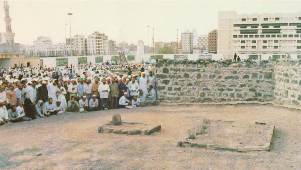
The Imam was poisoned by the ruler of the time, Walid son of Abdul Malik. Imam Zaynul Abideen (AS) died on 25th Muharram 95 AH at the age of 57. On this day, when the Imamaat of the fourth Imam (AS) ended, the 5th Imam, Imam Muhammed Baqir (AS) became the Imam of the time. Imam Zaynul Abideen (AS) has been buried in Janatul Baqi, next to his uncle, Imam Hassan (AS).
Lessons we can learn from the Imam’s life.
Shaykh al-Toosee writes that once Abu Hamzah al-Thumaalee saw Imam Ali ibn al-Husayn saying his prayers and his cloak slipped from his shoulders. The Imam did not arrange it. After the prayers Abu Hamzah asked him about it. The Imam responded: Woe to you, don't you know before whom I stood?
The 5th Imam has said that his father was titled As-Sajjad because he did sajdah whenever :
1. He received a blessing.
2. He finished any salaa.
3. Whenever he heard a Qur'anic verse of sajda.
4. When a difficulty was averted.
5. When he arranged peace between two people.
The mark for sajdah was seen on all the 7 parts of his body which touch the ground during sajdah.
References
1. “Islamic Religious Education” – Book 4
2. http://www.hujjat-workshop.org/index.cfm?content=534