 |
"May Allah bestow upon us and upon you great reward for grief of Imam Hussein (as), and make us and you amongst those who will assist Imam Mahdi (altf) to avenge his killing."
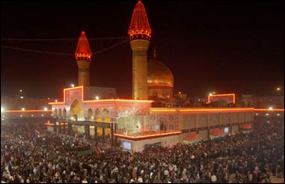
Karbala is the story of an exceptional man who left the comfort of his home to live in plains of tragedy and misery to fight against the Kuffar who had been polluting the world after the time of the Prophet. His fight was to restore freedom, peace, equality and justice, all qualities which represent our prefect religion and keeps it alive until today.
|
Approximately, 1400 years ago an emotionally broken and distraught man stood on the plains of Karbalaa and cried, ‘Hal Min Nasirin Yansura, Hal Min Mugeethun Yugeethuna’ - Is there any helper to help us? Is there any rescuer to rescue us?' The same man whose backbone had been broken from the tragedy of H. Abbas, Whose eyes had lost their light from the martyrdom of his son who resembled the Prophet, H. Ali Akbar, Whose heart shattered in pieces when the body of his young nephew H. Qasim was trampled upon, The same man, who would soon take his 6 month year old son H. Ali Asghar, to the battlefield to quench his thirst, but instead it be replaced with a three-pronged arrow. Our Imam even sacrificed a 6 month year old baby in the way of Allah (swt) and to save Islam from being in the hands of the munafiq. This is the same Imam whose body was showered upon by arrows, the Imam who was beheaded whilst in sujuud.
We as followers of Ahlul Bayt use the Imams as our role models, and in particular Imam Hussein (a.s) shows us how even on the plains of battle he stopped his defence in order to submit to Allah at the time of namaz. In a battle where lives were at stake, the wajibats of namaz were not missed.
Imam Husayn (as) stopped his defence in order to submit to Allah at the time of namaz. In a battle where lives were at stake, the wajibats of namaz were not missed.
Karbala shows the importance of namaz even in critical times, but how important do we regard it today? When called at the time of Adhan to adorn prayers, how many of us, are too tied up in worldly affairs to give the namaz’s fadhilat any notice?
Is the delaying of our namaz not proof enough that we are prepared to submit before worldly matters instead of Allah? It is ironic as whatever it is we are so busy doing is something that Allah has blessed us with, but we are too occupied to give thanks.
The land of Karbala and the day of Ashura is alive inside us. It represents the battle of our nafs that we face every moment of our lives. In the war against shaytan, how committed are we to stand firm? How many of us have been defeated and let our Imam down from the call of Hal Min Nasirin Yansura? It is this battle of the nafs that our Holy Prophet refers to as the greater jihad.
A hadith states that when a person begins to offer Salat, Allah listens to what his servant is saying until the person loses concentration twice. Allah then, “turns His face away from us.’
Another tradition states that Allah says to His servant: “When you pray to me I pay attention to you as if I have no other servants, but when you pray, you do so as if you had 100 gods!”
Allah has created us selflessly, a master who looks after us, feeds us, clothes us and blesses us with infinite mercies with no obligations until the age of buloogh when it becomes wajib upon us to fast, pray, pay khums etc. All of these wajibats are not for his benefit but simply for ours; and for us to get closer to him, Ahlulbayt (as) and to paradise.
Saying this, it is important for us to not turn Namaaz from being a divine conversation between master and servant to a ritual that we are obliged to carry out. There is a hadith that says there are 3 types of Namaz: One of which is fully accepted, One which is only partially accepted, and
The third type is when the Salat is folded like a rug and used to beat the head of that who offered it.
However, on the other hand Imam Jaffer Sadiq (a.s.) says
“Performing two Raka’at with concentration is better than staying all night performing Salats without concentration”
To assist us in this, our Ulema’s, such as Ayatollah Behjat, was asked ‘How does one achieve a presence of mind in salaa to control ones thoughts to ensure concentration’ – He replied ‘Before you begin salaa, sincerely seek the intercession of Our Awaited Imam to help you in your concentration.’
Other traditions state, before we begin salaa we should try and have a 100% concentration whilst doing wudhoo, which will increase concentration in salaa, as well as creating a habit of reciting adhaan and iqama which has a number of benefits, as well as increasing concentration in Salaa.
Let us take advantage of the days of Muhurrum in which we strengthen our beliefs and make firm our commitment to walking on the right path. The days which have passed and will approach, are not just a simple tradition where we sit in the mosque and cry; let us make this Muhurrum a revolution within us. Let us take the message of Karbalaa and apply it into our lives today. Whether it be to fight against tyrants when our religion is made a mockery of as did Imam Husayn (as), to speak out against injustice as Bibi Zainab (as), to turn back to Allah and repent as Janabe Hur, or to even value and honour our friendships as Habib ibn Mazahir as ‘Every day is Ashura, Every land is Karbala’
The Islam which Imam Husayn (as) and Bibi Zainab (as) fought for is now our amanat for safekeeping until our Living Imam comes, may Allah hasten his re-appearance, and until then let us keep Islam in its true form alive.