Throughout his perfect life, Prophet Muhammad earned himself many titles – the two most famous of them being As Sadiq (The Truthful) and Al Ameen (The Trustworthy). There was, as always, reasons behind it. He was named As Sadiq because of many scenarios, the most well known being the following:
Prophet Muhammad had once said to his people “If I told you there was an army behind that hill, would you believe me?” His people said yes. The Holy Prophet then said, “What if you then looked behind the hill and saw that there was no army, would you still believe me?” The people responded in saying, “We will not believe our eyes, but we will still believe you.”
Al Ameen became another of his titles because, of course, of how trustworthy he was. He was trustworthy to the extent that when people went on holiday, they left their most valuable possessions with him. This continued even after the Prophet announced that he was a Prophet. Also, when Prophet Muhammad left Medina, he strictly told Imam Ali to first and foremost return the belongings of other people back to them.
Another two things that we associate with Prophet Muhammad are Masjid al-Nabawi and the move from Makkah to Medina which is known as Hijrah. These two things are related, as you will find out in this following story.
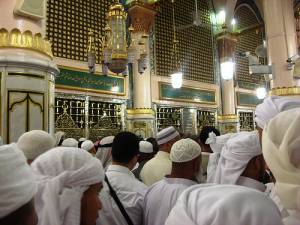
After Prophet Muhammad announced his Prophethood and the people of Makkah were mocking him, the holy Prophet decided to migrate to Medina. Fortunately the people of Medina greeted him warmly and were happy for him to be there. One of the first things he did was build a mosque for the Muslims. To do this he first bought a piece of land that had belonged to two orphans. Then he, with help from the other Muslims, began clearing the plot of land and building the mosque. Hence, Masjid al-Nabawi. This holy mosque was not, however, only used for praying Namaaz. It was used for reciting Qur’an, gaining knowledge, helping the people with any problems and doing things alike. Muslims came there to listen to the Holy prophet when he arrived to give lectures and on the occasions in which he was not there, other faithful companions taught others what the prophet had taught them.
Gaining knowledge plays a huge part in Islam. Prophet Muhammad was once inside Masjid al-Nabawi when he saw two groups, the first reciting Duas and Qur’an, the second gaining knowledge. He said “They are both doing useful things but I am a teacher so I will go and join the group that has assembled to learn.”
Prophet Muhammad believed in equality as much as he did in gaining knowledge. Once, when the Holy Prophet was sitting in a mosque giving a lecture, a rich man with expensive clothes came and sat down to listen to the lecture. Not long after, a poor man wearing dirty, ragged clothes came and sat down next to him. The rich man did not like for the poor man to sit next to him so he moved himself further away. Prophet Muhammad noticed this and was disappointed. He asked the rich man why he had done this. Was it because he was afraid that some of his wealth would go to the poor man or some of the poor man’s poverty would go to him? The rich man realised his fault and, to show how sorry he was, offered the poor man half of his wealth. To his astonishment, the poor man refused saying that he was afraid that the wealth might make him think he was superior to the rest of his community.
The Prophet also did not think himself superior to others and always did his share of the work. The Prophet has said, “I have been sent to perfect your manners”. He showed this in the following scenario:
The Holy Prophet and some of the Muslims once went on a journey. After travelling for some time, they got tired so they stopped to have some food and rest. They divided the jobs quickly. One man said that he would go and kill a lamb so that they could cook it. Another said that he would remove the skin of the lamb before it was cooked. A third man said that he would light the fire and cook the meat. The Holy Prophet then said that he would collect the firewood from the forest. At this all the men said that they would and could do all the work themselves; the Prophet could just relax. The Prophet replied saying that he knew they could do all the work but Allah does not like people who sit back and let other people do all the work.
This story tells us that in Allah’s eyes we are all equal so we should not think ourselves superior to others.
The Prophet has shown this message throughout his life. He has also taught us that you need to be truthful, trustworthy, hard working, polite, humble and forgiving in order to be the perfect human being/Muslim.
References
Lesson in our faith from the lives of the Ahlul Bayt
Excellent Stories volume 1 – Q Fatima
Youth article by Sumayya Hemraj